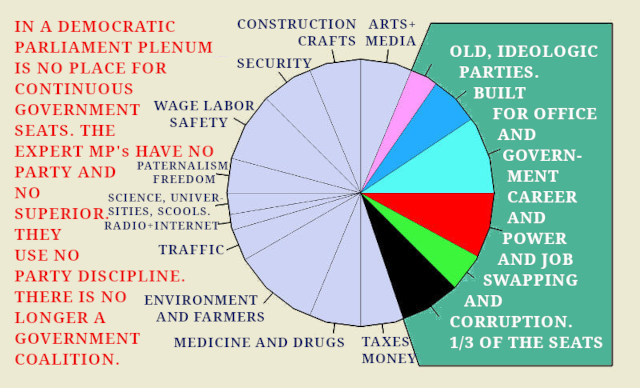
NO PARTY LEADERS IN THE GOVERNMENTS
ELECTED, EQUAL RANGED REPRESENTATIVES IN THE PARLIAMENTS
| Here in the /pd/ pages (parliamentary democracy) I write about the democratic separation of powers, PARLIAMENTARY DEMOCRACY, the opposite of the monarchy and other dictatorships in which the government has absolute power over everything. Even over the controllers who are supposed to monitor it. |
Here I write about the lie of socialist social madness. About the animal pack formation that feigns strength to the idiots in the pack when in fact only their numbers are needed in elections for the government power of the "boss".
Refts and Lights, Christians and Liberals, all the same liars. |
|
Even if you can't imagine it: I don't collect money, I don't even want to know who you are and I don't want to found a group or party, church, sect or any other society. The opposite, I see my goal and my task as weakening all groups with hierarchies and leaders, and if possible destroying them. NGOs, parties, clubs, lodges, churches, sects, groups of children, sports, nature, singing, all those who have a hierarchy and strive for power. Leaders look fpr weak people. Leaders are constantly looking for weaklings who will turn dirty work to their advantage, like bandit chiefs. |
|
I believe that the three-power system (the exact name for the separation of powers) is the solution to the problems that have broken out in the world since the Enlightenment as a result of the lust for power of the party leaders and presidents in the governments.
Parliament should not make day-to-day political decisions, it should only write the generally valid, long-term rules, the laws and regulations for everyone, for the courts, for the governments and for the bureaucrats. For other reasons that are explained on the /pd/ pages, parliaments must monitor the entire executive (that is, the government and its civil service apparatus in municipalities, states and the federal government and the federal president) to ensure that the laws are complied with and bring them to court. |
PARLIAMENTARY DEMOCRACY, the THREE POWER PRINCIPLE is not my invention. But I imagine that I have caught the party power-hungry people tampering with the world's constitutions against democracy and even against the "Republic" (a matter for the people) and the separation of powers.
The electorate did not notice this, and always relied on the decency of their party leaders and lawyers. But their government power and the hierarchy in the bureaucracy are more important to them than the people and their parliament. Civic education promotes pyramidal, hierarchical authoritarian thinking instead of putting parliamentary balancing democracy in the foreground. |
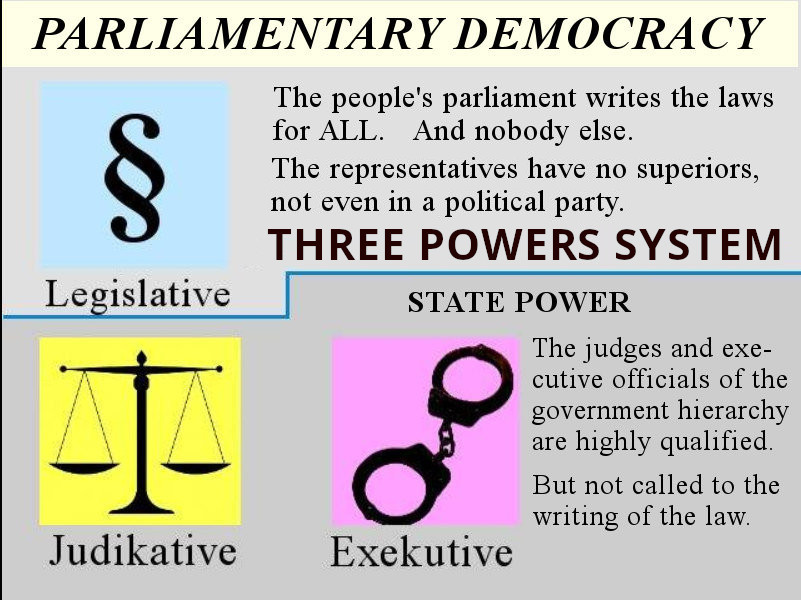
Parliament is democratic.
The state apparatus in the republic is an employee of parliament
similar to how the board of directors and employees of a stock corporation
are subject to the rules and audits of the supervisory board.
The general meeting is called the National Council or state parliament election.
|
The interests of Christians and the interests of workers were only artificially set against each other by ideologists and churches during the imperial era. The emperor in Vienna was deeply Catholic, the emperor in Berlin was casually Protestant. The dividing line would have been more precisely drawn between the civil servants and the hard-working subjects. After the First World War in 1920, it was no different, but the parties were controlled from above, from the capitals. And the parties led the subjects by the nose from the capital, and also from the state capitals. And they, the executive servants, installed their own jurisdiction for their exclusivity, administrative courts at the federal level and in 9 states. The parliament of the sovereign is too vulgar for them. Parliamentary democracy cannot afford self-appointed elite, competing bypass organizations like the WEF in Davos. | Such organizations have always arisen for the purpose of weakening parliamentary democracy. My goal is a more modern composition of parliaments with much more power for voters and their vital interests at the election and much less legislative lobbying power for the parties and the experts and the chambers after the election except as elected and discussing equally ranked MP's in the parliament. Eliminating the parties is not possible at the beginning, but the ideological parties in the House of Representatives, in the parliaments, must be reduced to have little influence on the elected representatives (party discipline) and especially little influence on the formation of a government made up of highly qualified, non-party officials. I could even imagine a "Bierlein" government (a famous lady who formed a perfect government with officers and without party bosses) being formed in the middle of the elections, but without an ex-Kaiser Federal President from the parliament. | |